Date: Sep 14, 2026 Day: Monday
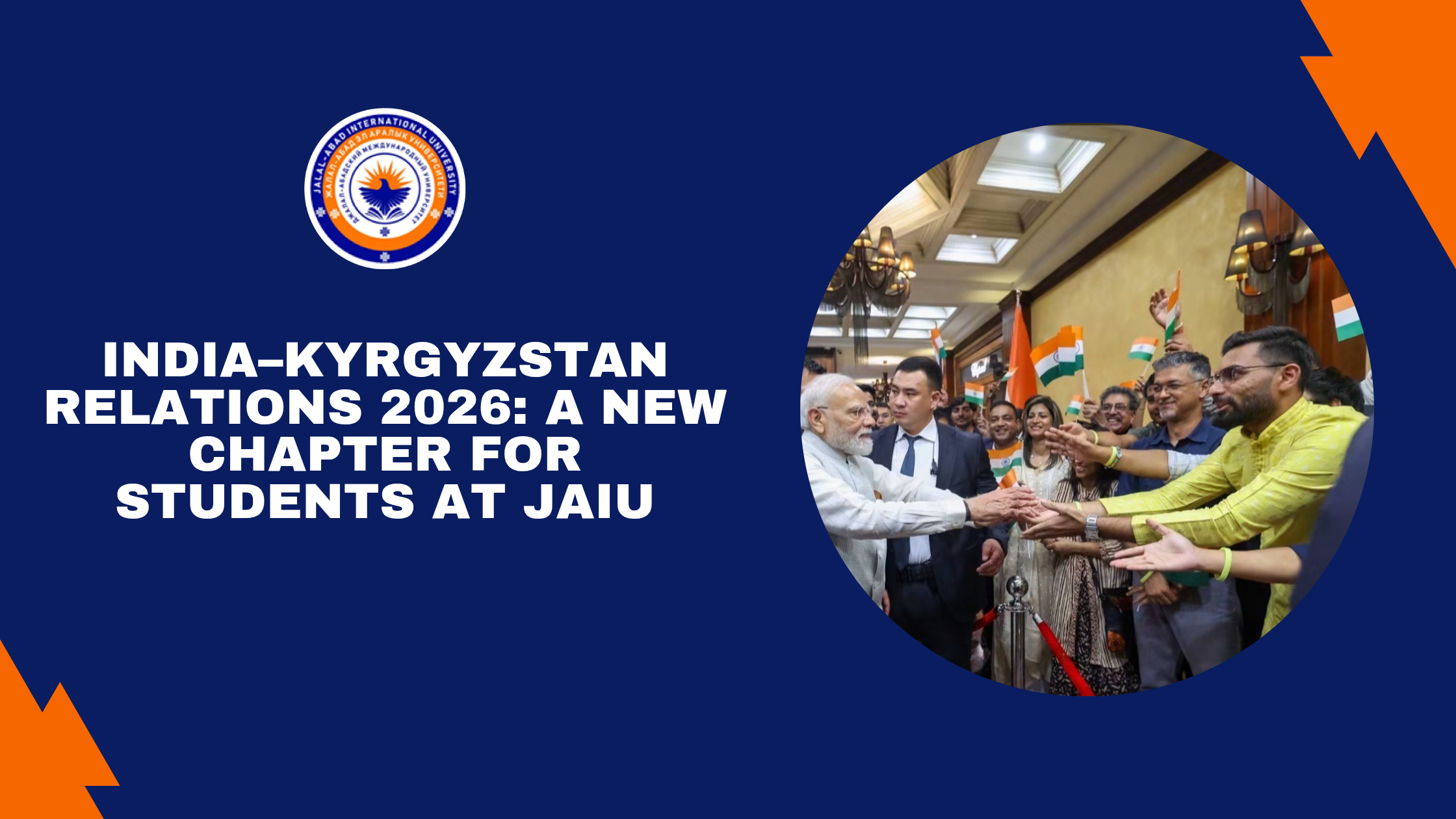
India and Kyrgyzstan have maintained close relations across areas such as education, culture, trade and people-to-people connections. In 2026, the relationship received renewed attention following Prime Minister Narendra Modi’s visit to Kyrgyzstan and his meeting with President Sadyr Zhaparov in Bishkek.
For students studying in Kyrgyzstan, developments in India–Kyrgyzstan relations are particularly relevant because education is one of the important links connecting people from both countries. Jalal-Abad International University (JAIU), with its multicultural student environment and international academic focus, provides an example of how higher education can contribute to these people-to-people connections.
Prime Minister Narendra Modi met Kyrgyz President Sadyr Zhaparov in Bishkek on 31 August 2026, on the sidelines of the Shanghai Cooperation Organisation (SCO) Summit.
According to the Government of India, the two leaders reviewed progress in bilateral relations and reaffirmed their commitment to strengthening the India–Kyrgyzstan Strategic Partnership. Discussions covered economic and commercial cooperation as well as growing people-to-people ties, including student exchanges and cultural collaborations.
The reference to student exchanges is particularly relevant for the education sector because thousands of young people build international experiences through universities, academic programmes and cultural interaction.
International education creates connections that extend beyond classrooms.
An Indian student studying in Kyrgyzstan experiences a different academic environment, interacts with students from different countries and becomes familiar with the culture and society of the host country.
At the same time, universities in Kyrgyzstan become places where students from India and other countries can interact with local communities.
This makes education an important part of people-to-people relations. The focus on student exchanges and cultural collaboration during the 2026 India–Kyrgyzstan discussions reflects the broader importance of these connections.
Jalal-Abad International University has developed an international orientation within its academic environment.
JAIU's Office of International Relations describes the university as having a multicultural student body representing more than 10 nationalities. The office also works on international student recruitment, academic mobility, research collaboration, partnerships and cultural integration.
For Indian students, this international environment can provide an opportunity to experience medical education alongside classmates from different cultural and educational backgrounds.
Such an environment can help students develop communication skills, adaptability and awareness of different perspectives—qualities that are increasingly relevant in a globally connected healthcare sector.
JAIU has a dedicated Office of International Relations and Investment that serves as an institutional link between the university and international academic communities.
According to JAIU, the office works on areas including international student admissions support, partnerships, academic mobility, research collaboration and cultural integration. It also states that JAIU students and faculty engage with partner institutions in countries including India, the UAE, Uzbekistan, Kazakhstan and European countries.
This international structure provides a framework through which students can participate in academic and cultural activities beyond their immediate classroom environment.
One of the areas where international relations can directly connect with student development is academic mobility.
JAIU has an academic mobility framework that includes exchange programmes, internships and cooperation with partner educational organisations. Its regulations describe external academic mobility as opportunities for JAIU students to study or undertake educational activities at foreign universities and organisations.
For medical students, international exposure can provide opportunities to understand different academic systems, healthcare environments and approaches to learning.
However, individual mobility opportunities depend on applicable agreements, selection procedures, academic performance and other university requirements. They should therefore be viewed as opportunities within an institutional framework rather than as automatic benefits for every student.
The 2026 developments do not mean that every student will automatically receive a new scholarship, exchange programme or special academic facility.
Instead, the significance lies in the continued emphasis on connections between people and institutions.
For Indian students at JAIU, this broader relationship can be understood through several areas:
Students themselves become part of international relations through everyday interaction, cultural participation and academic life.
Diplomatic discussions that highlight student exchanges demonstrate the importance of education within wider bilateral relationships.
JAIU's international relations structure includes academic mobility, institutional partnerships and research collaboration, creating channels for international academic engagement.
Studying abroad is also a cultural experience. Indian students can learn about Kyrgyz culture while sharing their own traditions with classmates and local communities.
Moving to another country for medical education involves more than academic preparation.
Students may need assistance with admission procedures, visas, arrival, orientation and adjustment to a new environment.
JAIU's International Relations Office states that it supports international students through areas including admission guidance, visa and arrival processes, orientation, cultural integration and student welfare.
JAIU also has formal policies related to language and sociocultural adaptation and an international student adaptation programme. These policies indicate that international student integration is recognised within the university's institutional framework.
A medical classroom can bring together students from multiple countries.
For an Indian student, studying at JAIU can therefore involve interaction not only with Kyrgyz students and institutions but also with classmates from different parts of South Asia and other regions.
This multicultural setting can encourage students to communicate with people from different backgrounds and develop greater cultural awareness.
For future doctors, such skills can be valuable because healthcare professionals frequently work with patients and colleagues from diverse communities.
Government-to-government relations are only one part of an international partnership.
Students, teachers, researchers and universities also contribute to long-term connections between countries.
When an Indian student studies in Kyrgyzstan, participates in academic activities and develops relationships with people in the host country, that experience can contribute to broader people-to-people understanding.
Similarly, academic partnerships, mobility programmes and cultural activities can create connections that continue beyond an individual student's university years.
The emphasis on student exchanges and cultural collaboration during the 2026 Modi–Zhaparov meeting highlights this wider role of people-to-people relations.
For students considering medical education at JAIU, the university's current applicant information provides details about the 2026 admission process. JAIU states that international applicants from distant countries can apply through the official WCIEC Studyzone process, while Indian applicants are required to provide NEET results among the listed admission documents.
Students should always verify the latest admission requirements, programme structure, documentation and applicable regulations directly with the university before making an application.
The broader India–Kyrgyzstan relationship can provide useful context, but a student's decision about medical education should ultimately be based on verified academic, regulatory and personal considerations.
India–Kyrgyzstan relations in 2026 continue to include important connections in strategic cooperation, culture and education. Prime Minister Narendra Modi's August 2026 meeting with President Sadyr Zhaparov specifically highlighted the importance of growing people-to-people ties, including student exchanges and cultural collaboration.
For JAIU, this wider relationship is relevant because the university already has an international academic structure that includes international student support, academic mobility, partnerships and research collaboration.
As Indian students continue to explore medical education in Kyrgyzstan, universities such as JAIU can serve as academic environments where education and cross-cultural interaction come together.
The next chapter of India–Kyrgyzstan relations will not be shaped only by governments. Students, universities, researchers and communities will also play a role in strengthening the human connections between the two countries.
All Blog Posts

 Jalal-Abad State University Gets Key Clarification for Indian MBBS Aspirants in Kyrgyzstan
How JAIU Students Can Make Their Clinical Training More Meaningful
How Technology Is Transforming Medical Education at JA
From Classroom to Clinic: How JAIU Students Develop Practical Medical Skills
PM Modi’s Kyrgyzstan Visit and the Growing India–Kyrgyzstan Education Connection: What It Means for JAIU Students
Jalal-Abad State University Gets Key Clarification for Indian MBBS Aspirants in Kyrgyzstan
How JAIU Students Can Make Their Clinical Training More Meaningful
How Technology Is Transforming Medical Education at JA
From Classroom to Clinic: How JAIU Students Develop Practical Medical Skills
PM Modi’s Kyrgyzstan Visit and the Growing India–Kyrgyzstan Education Connection: What It Means for JAIU Students