
Date: Sep 15, 2026 Day: Tuesday
Medical education is not limited to textbooks, lectures and examinations. For a future doctor, clinical training is where theoretical knowledge begins to connect with real patients, clinical situations and professional responsibilities.
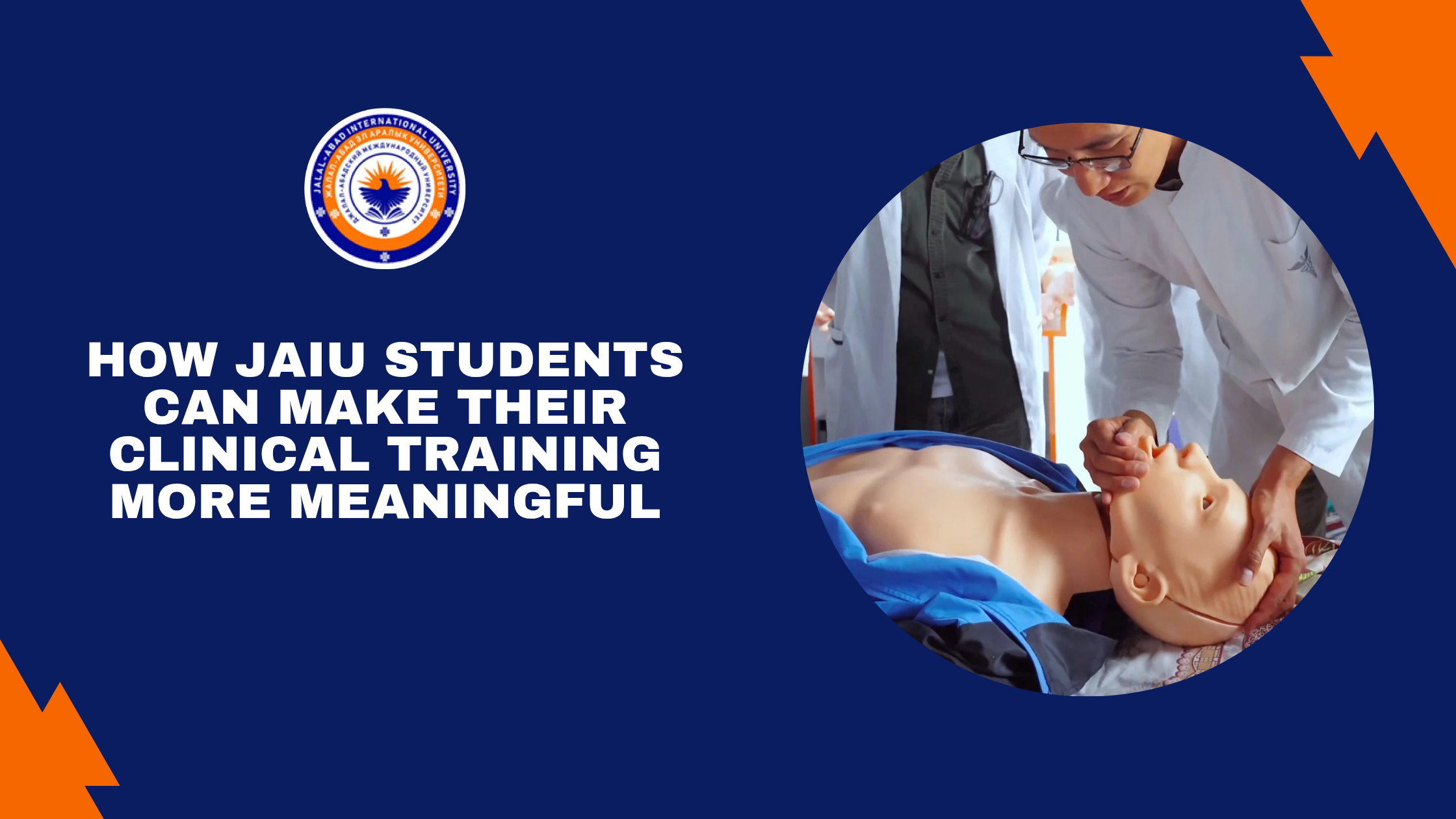
At Jalal-Abad International University (JAIU), medical students are introduced to practical and clinical learning through simulation training and clinical sessions. The university's current clinical education framework includes early clinical exposure, simulation-based training, clinical case discussions, bedside teaching and different forms of practical assessment.
However, simply attending clinical sessions is not enough. Students can gain much more from their training when they approach every clinical opportunity with curiosity, preparation and active participation.
The primary purpose of clinical training is to help students connect medical knowledge with real situations.
A student may learn about a disease in a textbook, understand its symptoms in a lecture and memorise its treatment. Clinical training provides an opportunity to see how those concepts appear in an actual patient.
This transition from theoretical learning to clinical application is an important part of becoming a medical professional.
JAIU's clinical education approach includes activities such as patient observation, clinical case analysis, communication skills and practical procedures under appropriate supervision.
Students can therefore approach clinical training as an opportunity to understand not only "what" a disease is, but also how healthcare professionals evaluate and manage a patient.
One of the simplest ways to make clinical training more meaningful is to prepare beforehand.
Before attending a clinical session, students can revise:
For example, if a student knows that the next session will involve respiratory medicine, revising common respiratory conditions beforehand can make observations during the clinical session easier to understand.
Preparation also helps students ask better questions.
Clinical training is not simply about watching doctors work.
Students should observe how healthcare professionals approach a patient from the beginning of an interaction.
They can pay attention to questions such as:
JAIU's clinical disciplines department specifically emphasises the development of clinical thinking and communication skills alongside practical medical education.
These observations can help students understand the reasoning behind clinical decisions.
Clinical cases can turn theoretical knowledge into practical thinking.
Instead of studying a disease only as a list of symptoms, students can ask themselves how they would approach a patient presenting with those symptoms.
A simple framework can be:
Patient complaint → History → Examination → Possible diagnoses → Investigations → Diagnosis → Management
Students should not try to make independent clinical decisions about real patients. Instead, under faculty supervision, they can use cases as learning exercises to understand how doctors develop clinical reasoning.
JAIU's educational framework includes case-based learning and clinical case analysis as part of medical education.
Simulation is an important bridge between classroom learning and clinical environments.
JAIU's Simulation Center provides a controlled setting where students can practise clinical skills before working with real patients. The center uses phantoms, standardized patients and simulation scenarios, while OSCE and OSPE provide structured practical assessment.
Students should use these opportunities actively.
If a procedure feels difficult during simulation, practising it again can help build familiarity before the student encounters a similar situation in a clinical setting.
JAIU is also developing digital simulations and incorporating VR/AR elements into its simulation environment.
A doctor needs more than medical knowledge.
Patients may be anxious, confused, uncomfortable or unable to explain their symptoms clearly. Learning how to communicate respectfully is therefore an important part of clinical development.
Students can practise:
JAIU's clinical education framework places emphasis on communication skills alongside clinical competencies.
For international students, this can be especially valuable because they may interact with patients and healthcare professionals from different cultural and linguistic backgrounds.
Clinical training becomes more valuable when students actively engage with their teachers and mentors.
Instead of remaining silent when something is unclear, students can maintain a list of questions and discuss them at an appropriate time.
Good questions might include:
Asking thoughtful questions demonstrates that the student is trying to understand the reasoning behind clinical practice rather than simply memorising information.
Students can maintain a personal learning record during their clinical years.
After each session, they can write down:
What I observed
What clinical situation or procedure did I see?
What I learned
What new concept became clearer?
What I found difficult
Which topic or skill needs further revision?
What I want to learn next
Which question should I explore before the next session?
This habit can gradually create a personal clinical learning portfolio.
JAIU's student resources include a regulation related to student portfolios, alongside regulations covering clinical assessment methods such as OSCE, Mini-CEX, DOPS and 360-degree assessment.
Feedback is one of the most useful parts of practical training.
A student may believe that they have performed a procedure correctly but discover through faculty feedback that their communication, technique or sequence needs improvement.
Students should therefore treat feedback as part of the learning process.
Instead of focusing only on grades, they can ask:
What did I do correctly?
What should I improve?
How can I practise it better next time?
This approach can turn every clinical session into an opportunity for gradual improvement.
Clinical learning should happen within the appropriate supervision and educational framework.
Students are learners, not independent practitioners. Real patients require professional care, confidentiality and safety.
JAIU describes a progression in practical education from basic communication and patient-care skills toward diagnostic and therapeutic procedures and more advanced clinical responsibilities under teacher supervision.
Students should therefore follow the instructions of clinical faculty and mentors and never perform procedures independently when they are not authorised or adequately trained to do so.
One of the biggest changes during clinical education is recognising how different medical subjects connect.
Anatomy helps explain physical findings.
Physiology helps explain how the body functions.
Pathology helps explain disease processes.
Pharmacology helps explain treatment.
Microbiology helps explain infections.
Clinical medicine brings these areas together while evaluating a patient.
Students should therefore avoid treating each subject as completely separate.
When seeing a clinical case, they can ask themselves:
Which basic science concepts explain what I am seeing?
This approach can make medical learning more connected and easier to remember.
JAIU's current clinical-base information states that students participate in clinical sessions from the second semester onward, with exposure across areas including therapeutic, surgical, pediatric, obstetric-gynaecological, psychiatric and emergency care.
Early exposure gives students more time to gradually become familiar with the clinical environment.
Students should not feel pressured to know everything immediately.
The early stage should be about learning how hospitals and clinical environments work, developing communication skills, observing professionals and building basic clinical confidence.
Clinical training and assessment are closely connected.
JAIU uses practical assessment formats including OSCE, OSPE, Mini-CEX and DOPS.
Students can prepare by practising skills rather than simply reading about them.
For an OSCE-style station, for example, students may need to demonstrate a structured approach to communication, examination or a practical procedure.
Regular practice can make the sequence more familiar and help students identify areas that require improvement.
Modern clinical education increasingly combines hands-on practice with technology.
JAIU's Simulation Center includes simulation-based learning and is developing digital simulation, VR/AR elements and interactive formats.
Students can use these tools to visualise concepts, practise scenarios and reinforce theoretical learning.
However, technology should complement—not replace—real clinical interaction, faculty guidance and supervised patient care.
Every patient encounter can teach something different.
Even when the diagnosis is familiar, the patient's age, symptoms, medical history, communication style and response to treatment may be different.
Students should therefore focus on learning rather than simply counting the number of cases they have seen.
The question should not only be:
"How many patients did I see today?"
It can also be:
"What did today's patients teach me?"
This change in mindset can make clinical training more meaningful.
Clinical training is also the time to develop professional habits.
Students can practise:
These habits can become part of a student's professional identity long before graduation.
The transition from classroom learning to clinical education is gradual.
At JAIU, the medical education framework combines theoretical preparation, simulation, clinical practice and structured assessment. The university also identifies clinical bases and clinical mentors as part of its formal educational framework.
Students can make this journey more meaningful by being prepared, observing carefully, asking questions, practising skills, accepting feedback and connecting theory with patient care.
The goal is not to become an expert overnight.
The goal is to improve consistently.
Clinical training is one of the most important stages of medical education because it helps students connect knowledge with real healthcare situations.
At JAIU, students have access to simulation-based training, early clinical exposure, clinical case learning, practical assessments and supervised clinical environments.
But the quality of a student's clinical experience also depends on how actively they participate.
Preparing before sessions, observing carefully, communicating respectfully, asking meaningful questions, practising through simulation, maintaining a learning record and using feedback can help students gain more from their clinical education.
For an aspiring doctor, every clinical session is more than another class. It is another opportunity to understand patients, develop professional skills and gradually transform medical knowledge into clinical competence.
All Blog Posts

 Jalal-Abad State University Gets Key Clarification for Indian MBBS Aspirants in Kyrgyzstan
India–Kyrgyzstan Relations 2026: A New Chapter for Students at JAIU
How Technology Is Transforming Medical Education at JA
From Classroom to Clinic: How JAIU Students Develop Practical Medical Skills
PM Modi’s Kyrgyzstan Visit and the Growing India–Kyrgyzstan Education Connection: What It Means for JAIU Students
Jalal-Abad State University Gets Key Clarification for Indian MBBS Aspirants in Kyrgyzstan
India–Kyrgyzstan Relations 2026: A New Chapter for Students at JAIU
How Technology Is Transforming Medical Education at JA
From Classroom to Clinic: How JAIU Students Develop Practical Medical Skills
PM Modi’s Kyrgyzstan Visit and the Growing India–Kyrgyzstan Education Connection: What It Means for JAIU Students