Date: Sep 11, 2026 Day: Friday
India and Kyrgyzstan share a relationship that extends across diplomacy, education, culture, trade and people-to-people connections. In recent years, education has remained an important part of the interaction between the two countries, particularly as Indian students continue to explore higher education opportunities in Kyrgyzstan.
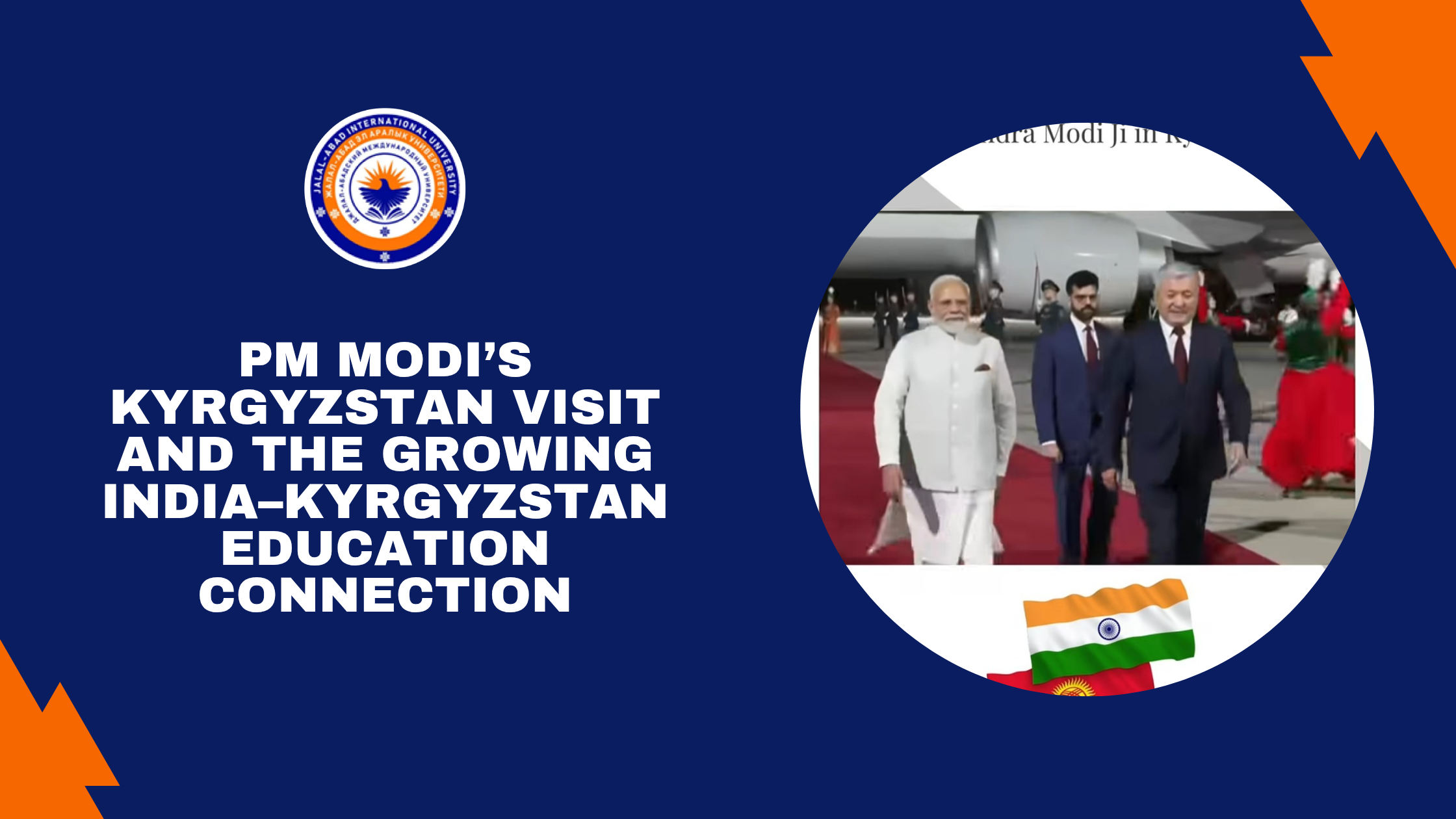
This relationship received renewed attention during Prime Minister Narendra Modi’s visit to Kyrgyzstan in August–September 2026. During his visit to Bishkek for the 26th Shanghai Cooperation Organisation (SCO) Summit, Prime Minister Modi met Kyrgyz President Sadyr Zhaparov on 31 August 2026. The two leaders reviewed bilateral relations and reaffirmed their commitment to strengthening the India–Kyrgyzstan Strategic Partnership. They also discussed growing people-to-people ties, including student exchanges and cultural collaboration.
For Indian students considering medical education in Kyrgyzstan, these developments provide useful context for understanding the broader relationship between the two countries.
Prime Minister Modi visited the Kyrgyz Republic from 31 August to 1 September 2026 to participate in the 26th SCO Summit in Bishkek. The summit marked the 25th anniversary of the SCO. During the visit, Modi also attended the opening ceremony of the World Nomad Games.
His bilateral meeting with President Sadyr Zhaparov focused on strengthening cooperation between India and Kyrgyzstan.
According to the Government of India, the two leaders discussed economic and commercial cooperation as well as people-to-people connections. Student exchanges and cultural collaborations were specifically mentioned as areas contributing to closer ties.
For students, this highlights the role that education and people-to-people interaction can play within the wider India–Kyrgyzstan relationship.
International education creates connections that can continue long after students complete their studies.
Indian students studying in Kyrgyzstan become part of an international academic environment while experiencing the country's culture and society. At the same time, universities in Kyrgyzstan become connected with students, educators and institutions from India.
The discussion of student exchanges during the Modi–Zhaparov meeting reflects this broader people-to-people dimension of bilateral relations.
For medical students, studying abroad can therefore involve both academic learning and cross-cultural experience.
Jalal-Abad International University (JAIU) has an international focus, with students from India and other countries forming part of its medical education environment.
JAIU's International Relations Office describes the university as having students from South Asia, Southeast Asia and other regions, while its faculty collaborates with researchers and institutions internationally. The university also identifies international academic mobility and cross-border research collaboration as areas of its international engagement.
This creates a multicultural environment in which students from different backgrounds can study medicine together.
The broader India–Kyrgyzstan relationship provides useful context for Indian students choosing to study at JAIU.
Students are not simply moving from one academic institution to another. They are entering a different country, adapting to a new environment and becoming part of an international student community.
At JAIU, Indian students can access academic and student-support structures designed for international learners. The university's current FAQ states that international students receive support in areas including admission, visa procedures, campus life and clinical education.
JAIU also maintains an International Relations Office that works on student mobility, international partnerships and cross-border academic cooperation.
Medical education is one of the areas in which Indian students have a visible presence in Kyrgyzstan.
JAIU's current information specifically lists Indian nationals among international applicants and requires a NEET scorecard for Indian applicants to its medical program.
The university also provides information for international students covering visa and registration procedures, accommodation, clinical education and academic support.
For an Indian student, understanding these systems before travelling can make the transition to studying abroad more structured.
One of the distinctive aspects of international medical education is the opportunity to study alongside students from different countries.
JAIU's international-relations information describes a diverse student body and a global academic outlook. The university's student-life information also highlights cultural activities and international student events on campus.
For Indian students, this environment can encourage interaction with classmates from different cultural and educational backgrounds.
Such experiences can help students develop communication, adaptability and teamwork skills that are relevant to modern healthcare environments.
India–Kyrgyzstan educational connections are not limited to admission and enrollment.
JAIU has an academic mobility framework covering student and staff mobility and international academic programs. Its International Relations Office works on opportunities involving academic cooperation and student mobility.
However, students should understand that individual exchange or mobility opportunities depend on eligibility, available programs and institutional arrangements. They should verify the specific opportunity before making plans.
The international student experience at JAIU also extends beyond academic lectures.
The university provides opportunities involving scientific conferences, student activities, cultural programs and research. Its International Relations Office also describes cooperation involving research and academic mobility.
For medical students, these activities can complement their formal education by providing opportunities to develop communication, presentation and professional skills.
For Indian medical students, studying abroad is only one stage of a longer professional journey.
Students should understand the applicable requirements for returning to India or pursuing medical practice in another country. Licensing, internship, registration and postgraduate requirements are governed by the relevant authorities and can change over time.
JAIU provides information and academic preparation related to international licensing examinations, including FMGE, PLAB and USMLE. Students should nevertheless verify the latest requirements directly with the relevant regulatory authority before making career decisions.
Diplomatic relationships are not built only through meetings between governments.
Students, educators, researchers, professionals and cultural communities also contribute to connections between countries.
The Modi–Zhaparov meeting specifically recognised student exchanges and cultural collaborations as part of the growing people-to-people relationship between India and Kyrgyzstan.
For Indian students at JAIU, this broader relationship provides an important backdrop to their educational experience in Kyrgyzstan.
While bilateral relations can create a positive environment for educational cooperation, students should still make individual decisions based on verified academic and regulatory information.
Before choosing a medical program, students should review:
These factors are more directly relevant to an individual student's decision than diplomatic developments alone.
JAIU's international-relations strategy focuses on connecting the university with the wider academic and healthcare community. The university describes international partnerships, student mobility, research collaboration and support for international students as important parts of its international engagement.
As India–Kyrgyzstan relations continue to include education and people-to-people connections, universities such as JAIU operate within this wider international environment.
For Indian students, this can mean studying medicine in a multicultural setting while developing academic and professional connections across borders.
Prime Minister Narendra Modi's August–September 2026 visit to Kyrgyzstan highlighted the continuing importance of India–Kyrgyzstan relations. During his meeting with President Sadyr Zhaparov, both leaders discussed strengthening the strategic partnership and recognised growing people-to-people connections, including student exchanges and cultural collaboration.
For Indian students at Jalal-Abad International University, the visit provides broader context for understanding the relationship between India and Kyrgyzstan.
JAIU's international student environment, International Relations Office, academic mobility initiatives and medical education infrastructure form part of the university's approach to international education.
Ultimately, an Indian student's medical journey at JAIU is shaped by many factors—academic effort, clinical learning, university support, personal adaptation and compliance with applicable medical regulations. The growing educational and people-to-people relationship between India and Kyrgyzstan provides an important background to this international learning experience.
All Blog Posts

 Jalal-Abad State University Gets Key Clarification for Indian MBBS Aspirants in Kyrgyzstan
How JAIU Students Can Make Their Clinical Training More Meaningful
India–Kyrgyzstan Relations 2026: A New Chapter for Students at JAIU
How Technology Is Transforming Medical Education at JA
From Classroom to Clinic: How JAIU Students Develop Practical Medical Skills
Jalal-Abad State University Gets Key Clarification for Indian MBBS Aspirants in Kyrgyzstan
How JAIU Students Can Make Their Clinical Training More Meaningful
India–Kyrgyzstan Relations 2026: A New Chapter for Students at JAIU
How Technology Is Transforming Medical Education at JA
From Classroom to Clinic: How JAIU Students Develop Practical Medical Skills