
Date: Oct 24, 2026 Day: Saturday
Medical education is about more than studying textbooks, memorising facts, and preparing for examinations. Becoming a doctor requires the ability to understand medical concepts, apply scientific knowledge, communicate with patients, and make responsible decisions in healthcare settings. Practical learning plays an essential role in connecting classroom knowledge with the skills required for a future medical career.
For students exploring medical education at Jalal-Abad International University (JAIU) in Kyrgyzstan, understanding the importance of practical learning can help them make informed decisions about their academic journey. Before choosing a medical programme, prospective students should learn how theoretical teaching, practical activities, and supervised clinical experiences contribute to a student's professional development.
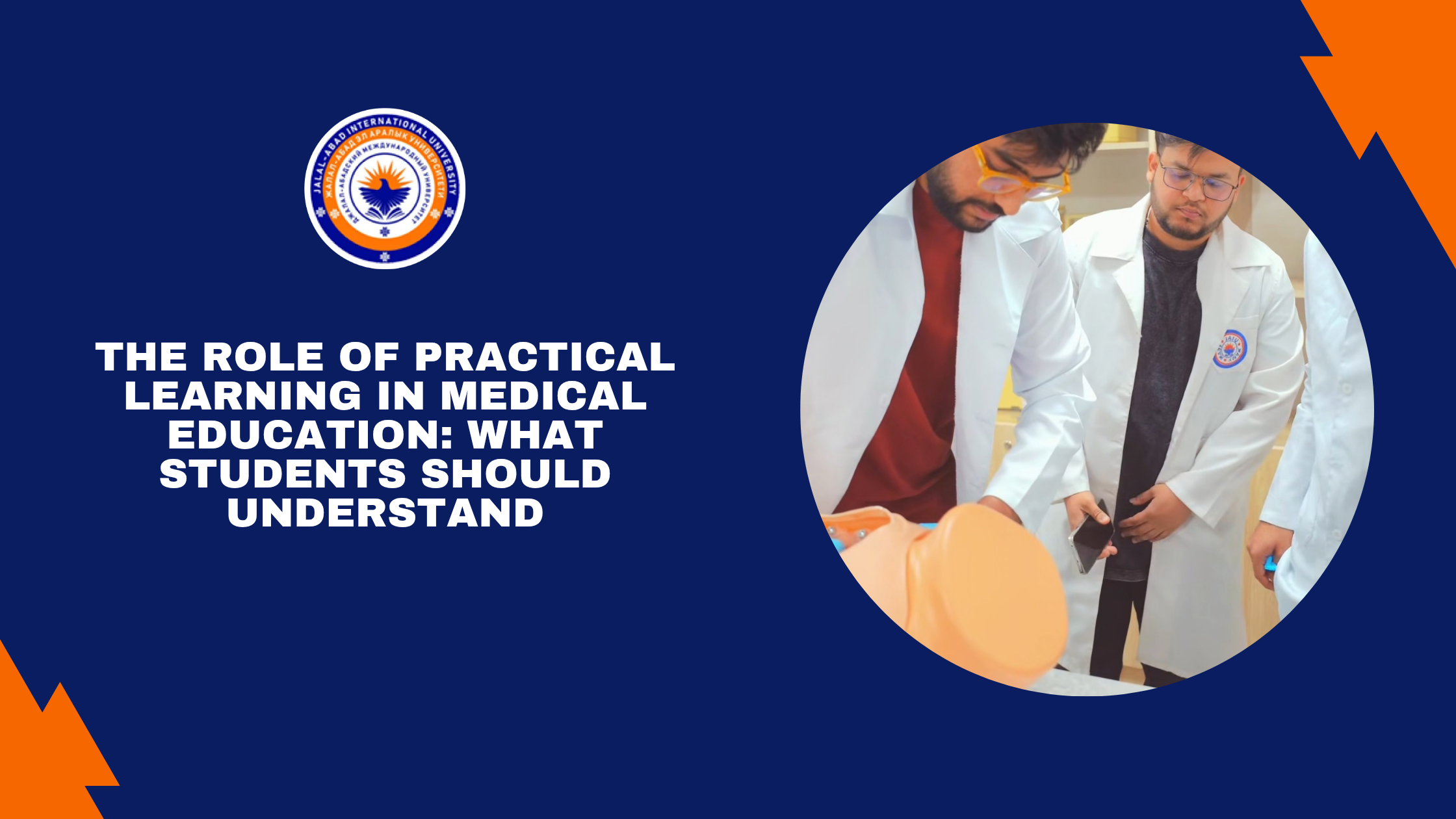
Practical learning refers to educational activities that help students apply theoretical knowledge through observation, demonstrations, supervised exercises, laboratory work, and clinical experiences.
In medical education, students must understand how the human body functions, how diseases affect different systems, and how healthcare professionals assess and manage medical conditions. Practical activities help make these concepts easier to understand by connecting scientific information with real-world applications.
Depending on the programme and stage of study, practical learning may include:
The specific activities available depend on the university's curriculum, facilities, and clinical training arrangements. Prospective students should review the official programme details to understand how practical learning is incorporated into their intended course.
Theoretical knowledge provides the foundation of medical education. Students study subjects such as anatomy, physiology, biochemistry, pathology, and pharmacology to understand how the human body works and how diseases develop.
However, understanding a concept in a textbook is different from applying it in a practical situation.
For example, a student may learn about the cardiovascular system in class. Practical demonstrations and structured case discussions can help the student understand how heart function relates to symptoms, clinical observations, and medical assessments.
Similarly, learning about microorganisms becomes more meaningful when students understand laboratory principles, infection prevention, and the role of hygiene in healthcare.
Practical learning strengthens this connection between knowledge and application. It encourages students to ask questions, examine evidence, identify relationships, and develop a deeper understanding of medical concepts.
Clinical skills are an important part of preparing for professional medical practice. Students gradually learn how healthcare professionals collect information, communicate with patients, recognise clinical concerns, and approach medical assessments.
Depending on their stage of training and the programme's structure, students may practise foundational skills through demonstrations, simulations, and supervised activities before progressing to appropriate clinical environments.
Examples of foundational clinical learning include understanding how to measure vital signs, take a patient history, communicate clearly, follow hygiene protocols, and recognise the importance of accurate documentation.
These skills require repeated practice, feedback, and careful supervision. Students should never assume that observing a procedure alone is sufficient preparation to perform it independently.
Medical training must follow the appropriate standards for supervision, patient consent, confidentiality, and safety. Developing clinical competence is a gradual process that requires both knowledge and responsible practice.
Doctors frequently encounter situations in which symptoms, medical histories, and clinical findings must be considered together. Effective medical decision-making requires careful reasoning rather than relying only on memorised information.
Practical learning can help students develop these abilities by encouraging them to analyse case studies, interpret observations, discuss possible explanations, and understand why different conditions may produce similar symptoms.
For example, a case-based learning activity might ask students to examine a hypothetical patient's symptoms and identify which additional information would help clarify the situation. The purpose is not simply to arrive at an answer but to understand the reasoning behind it.
Through guided discussions and constructive feedback, students can learn to recognise uncertainty, evaluate information carefully, and appreciate the importance of evidence-based medicine.
These habits are valuable throughout medical school and remain important as healthcare knowledge continues to develop.
Medical knowledge alone is not enough to provide effective healthcare. Doctors must also communicate respectfully, listen carefully, and explain information in ways patients can understand.
Practical learning can introduce students to these responsibilities through role-play, simulated consultations, communication exercises, and supervised clinical interactions where appropriate.
Students can learn how to ask relevant questions, listen without unnecessary interruption, maintain professional boundaries, and communicate sensitive information with care.
They must also understand the importance of patient privacy, informed consent, cultural awareness, and respect for individual differences.
Good communication helps healthcare professionals gather accurate information and build trust. Developing these skills early can help future doctors become more thoughtful, responsible, and patient-focused professionals.
Practical learning is most effective when students have opportunities to practise, receive feedback, identify mistakes, and improve their performance.
In medical education, errors during supervised learning can become opportunities for improvement when they are addressed appropriately and patient safety is protected.
Teachers and supervisors can help students understand which parts of a task were performed correctly, where further improvement is needed, and how to approach similar situations in the future.
Students should actively seek clarification when they do not understand a procedure or concept. They should also review feedback, revise relevant theory, and practise permitted skills within the appropriate learning environment.
This process encourages self-awareness and helps students recognise that clinical competence develops over time rather than through a single lesson or examination.
Students considering Jalal-Abad International University should examine how practical learning is integrated into the university's medical programme. Understanding the balance between classroom teaching, laboratory activities, skills training, and clinical experience can provide a clearer picture of the academic journey.
Prospective students should contact JAIU directly to confirm details about its current curriculum, practical teaching arrangements, available learning resources, clinical training locations, and supervision procedures.
Useful questions include:
Obtaining clear, current answers to these questions can help students evaluate the programme according to their educational needs.
Students should avoid assuming that every medical university offers identical clinical opportunities. Practical training arrangements can differ, so verifying the details of the specific programme is essential.
Students can take several steps to make the most of practical learning during medical school.
Build a strong theoretical foundation. Review relevant scientific concepts before laboratory sessions and practical demonstrations. Understanding the underlying principles makes it easier to follow procedures and ask useful questions.
Participate actively. Pay attention during demonstrations, take organised notes, and seek clarification when instructions or concepts are unclear.
Follow safety procedures. Laboratory rules, infection prevention practices, confidentiality requirements, and supervisory instructions must always be respected.
Learn from feedback. Treat constructive criticism as an opportunity to improve rather than as a personal failure.
Develop communication skills. Practise explaining ideas clearly, listening carefully, and working respectfully with classmates and healthcare professionals.
Reflect on each learning experience. Reviewing what went well, what was difficult, and what needs further study can help students identify areas for improvement.
Consistent preparation and a willingness to learn can make practical activities more meaningful and productive.
Practical learning contributes to the development of knowledge, judgement, communication, teamwork, and professional responsibility. These qualities help students prepare for the demands of further medical training and eventual professional practice.
However, completing practical activities during medical school does not automatically establish eligibility to practise medicine. Students must complete the applicable programme requirements and satisfy the registration and licensing rules of the country where they intend to work.
For Indian students considering medical education abroad, it is especially important to verify current National Medical Commission (NMC) requirements before enrolling. They should confirm that the programme and their planned educational pathway meet the relevant regulations.
Careful planning helps students understand how their medical education may connect with their long-term professional goals.
Practical learning is a fundamental part of medical education because it helps students connect theoretical knowledge with real-world applications. Through laboratory activities, supervised skills training, case discussions, and appropriate clinical experiences, students can develop stronger reasoning abilities, communication skills, and an understanding of professional responsibility.
For prospective students exploring medical education at JAIU, learning about the curriculum and practical training arrangements is an important step towards making an informed decision. Students should verify programme-specific details directly with the university and understand the licensing requirements relevant to their future career plans.
Becoming a doctor is a gradual process that demands curiosity, discipline, compassion, and continuous learning. By combining academic study with meaningful practical experience, aspiring doctors can build a stronger foundation for their future in healthcare.
Explore official resources:
Prospective students should confirm current curriculum details, practical training arrangements, and applicable regulatory requirements through official sources before applying.
All Blog Posts

 Jalal-Abad International University Organizes Campus Clean-Up Campaign to Promote Environmental Awareness
Jalalabad International University Students Participate in Inter-University Volleyball Tournament in Manas
Jalalabad International University Highlights Global Academic Engagement at Central Asian Education Forum 2026
Attention Future Doctors: MBBS Admission at Jalal-Abad International University Is Closing Soon
A Complete Guide to Studying MBBS at JAIU in Kyrgyzstan