
Date: Aug 11, 2026 Day: Tuesday
Medical education is no longer limited to classrooms, textbooks and examinations. As healthcare becomes increasingly global, medical students can benefit from exposure to different cultures, healthcare environments and academic perspectives.
For students pursuing MBBS abroad, international exposure can become an important part of their educational journey. Studying in another country allows students to experience a new environment while developing academic, communication and personal skills.
For students considering Jalal-Abad International University (JAIU) in Kyrgyzstan, the international environment can be viewed as one aspect of the broader medical education experience. However, students should evaluate international exposure alongside academic quality, clinical training, facilities, regulatory requirements and overall costs.
International exposure does not simply mean studying outside one's home country. It can include interacting with students from different countries, experiencing another healthcare environment, adapting to different cultural practices and learning to communicate with people from diverse backgrounds.
A medical student who studies abroad may encounter classmates with different experiences and perspectives. This can encourage students to become more open-minded and comfortable working with people from different cultures.
These experiences can be particularly relevant to medicine because healthcare professionals regularly interact with patients and colleagues from varied backgrounds.
One of the most noticeable benefits of studying MBBS abroad can be the opportunity to meet students from different countries.
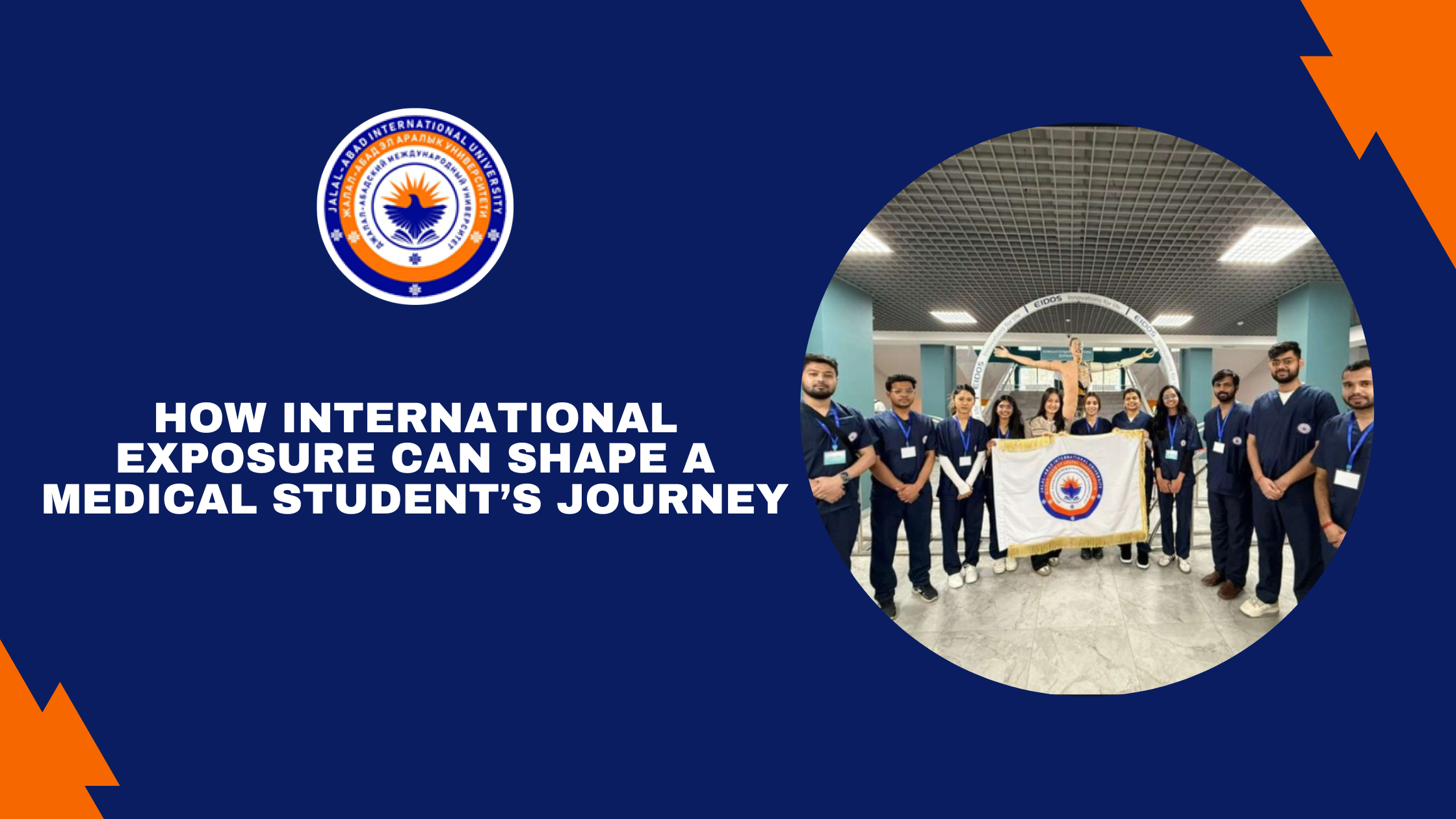
JAIU promotes an international student community and an educational environment involving students from diverse backgrounds. Jalal-Abad International University
For an Indian student, interacting with international classmates can provide a broader perspective beyond the student's familiar academic and cultural environment.
Students may learn about different educational systems, traditions and approaches to healthcare simply through everyday conversations and teamwork.
Communication is an essential part of medicine.
Doctors need to communicate clearly with patients, families, nurses, specialists and other healthcare professionals. Studying abroad can encourage students to become more confident when communicating with people who may have different accents, languages and cultural backgrounds.
Students may initially feel uncomfortable communicating in an unfamiliar environment. With regular practice, however, these situations can help develop confidence and adaptability.
Even learning basic local phrases can make everyday interactions easier.
Healthcare systems differ from country to country. Differences may exist in hospital organisation, patient communication, medical infrastructure, public health priorities and healthcare delivery.
Studying medicine abroad can give students an opportunity to observe a healthcare environment different from the one they grew up with.
This does not automatically mean that one healthcare system is better than another. Instead, exposure to different systems can help students understand that medical practice can operate in different social and organisational contexts.
Clinical learning is an essential part of medical education.
JAIU highlights practical medical education and clinical exposure as components of its programme, and its official information describes clinics and morphological centres associated with its medical infrastructure. Jalal-Abad International University
For students, the value of clinical exposure depends on the quality, structure and supervision of the training.
Prospective students should therefore ask specific questions about clinical rotations, affiliated facilities, patient exposure, supervision and the programme's compliance with applicable regulations.
A doctor needs to understand that patients can have different cultural backgrounds, beliefs and communication styles.
International exposure can help students become more aware of these differences.
For example, students may learn that communication styles, attitudes toward healthcare and family involvement can vary between communities.
Developing cultural awareness does not mean memorising every cultural difference. It means learning to listen, ask appropriate questions and avoid making assumptions about patients.
These skills can contribute to more respectful communication in future medical practice.
Living abroad often requires students to take greater responsibility for their daily lives.
Students may need to manage:
This independence can help students develop organisational and decision-making skills.
For young adults living away from home for the first time, these experiences can be just as valuable personally as they are academically.
Medicine itself is a field that requires continuous learning and adaptation.
Studying abroad can expose students to unfamiliar situations, from adapting to a new climate and culture to understanding a different academic routine.
These experiences can encourage flexibility.
Instead of expecting everything to work exactly as it did at home, students learn to understand new situations and find practical solutions.
Healthcare challenges can extend beyond national borders. Infectious diseases, public health issues, medical research and healthcare technology are often international concerns.
International exposure can help students understand that medicine is part of a broader global system.
Students can become more interested in international medical developments, research and healthcare practices while learning to evaluate information critically.
A global perspective can be useful regardless of where a student eventually chooses to practise medicine.
Another aspect of international exposure is the opportunity to develop friendships with people from different countries.
These connections can continue beyond university.
A student may eventually work with international colleagues, attend conferences or participate in academic activities involving people from different parts of the world.
However, students should remember that building a professional network takes time. The focus should first remain on education, communication and meaningful relationships rather than simply collecting contacts.
While international exposure can be valuable, it should not be the only reason to choose a medical university.
Students should first evaluate fundamental factors such as:
The international environment should be considered an additional benefit rather than a substitute for strong medical education.
Indian students planning to study MBBS abroad need to consider the requirements of the National Medical Commission (NMC).
The NMC maintains regulations and guidance concerning foreign medical graduates, including requirements related to medical education, course structure, medium of instruction and clinical training. NMC Rules & Regulations
Students should check the latest requirements applicable to their admission year before enrolling.
They should also verify the university's current information directly through official sources and maintain important academic and clinical documents throughout their studies.
JAIU presents itself as an international institution with students from different backgrounds. Its official website highlights an international student community, medical education and practical training. Jalal-Abad International University
For students considering JAIU, this environment can provide opportunities to interact with people from different cultures while pursuing medical education.
However, prospective students should speak with current students where possible and verify the latest information about campus life, academic activities and student support.
Simply living abroad does not automatically create a valuable international experience. Students need to participate actively.
They can:
The goal is not to change one's identity or culture. Instead, it is to become comfortable learning and communicating in a diverse environment.
International exposure can add an important dimension to a medical student's journey. Studying MBBS abroad can provide opportunities to experience a different academic environment, interact with international classmates, develop communication skills and gain greater cultural awareness.
For students considering Jalal-Abad International University, the university's international student environment and focus on practical medical education may provide opportunities for this kind of experience. Jalal-Abad International University
However, international exposure should always be considered alongside the fundamentals of medical education. Recognition, curriculum, clinical training, regulatory compliance, facilities and future career requirements remain essential.
Ultimately, the greatest value of studying abroad comes when students combine quality medical education with curiosity, adaptability and respect for different cultures. These qualities can help shape not only a stronger student, but also a more adaptable future healthcare professional.
All Blog Posts

 Jalal-Abad State University Gets Key Clarification for Indian MBBS Aspirants in Kyrgyzstan
How JAIU Students Can Make Their Clinical Training More Meaningful
India–Kyrgyzstan Relations 2026: A New Chapter for Students at JAIU
How Technology Is Transforming Medical Education at JA
From Classroom to Clinic: How JAIU Students Develop Practical Medical Skills
Jalal-Abad State University Gets Key Clarification for Indian MBBS Aspirants in Kyrgyzstan
How JAIU Students Can Make Their Clinical Training More Meaningful
India–Kyrgyzstan Relations 2026: A New Chapter for Students at JAIU
How Technology Is Transforming Medical Education at JA
From Classroom to Clinic: How JAIU Students Develop Practical Medical Skills