Date: Sep 01, 2026 Day: Tuesday
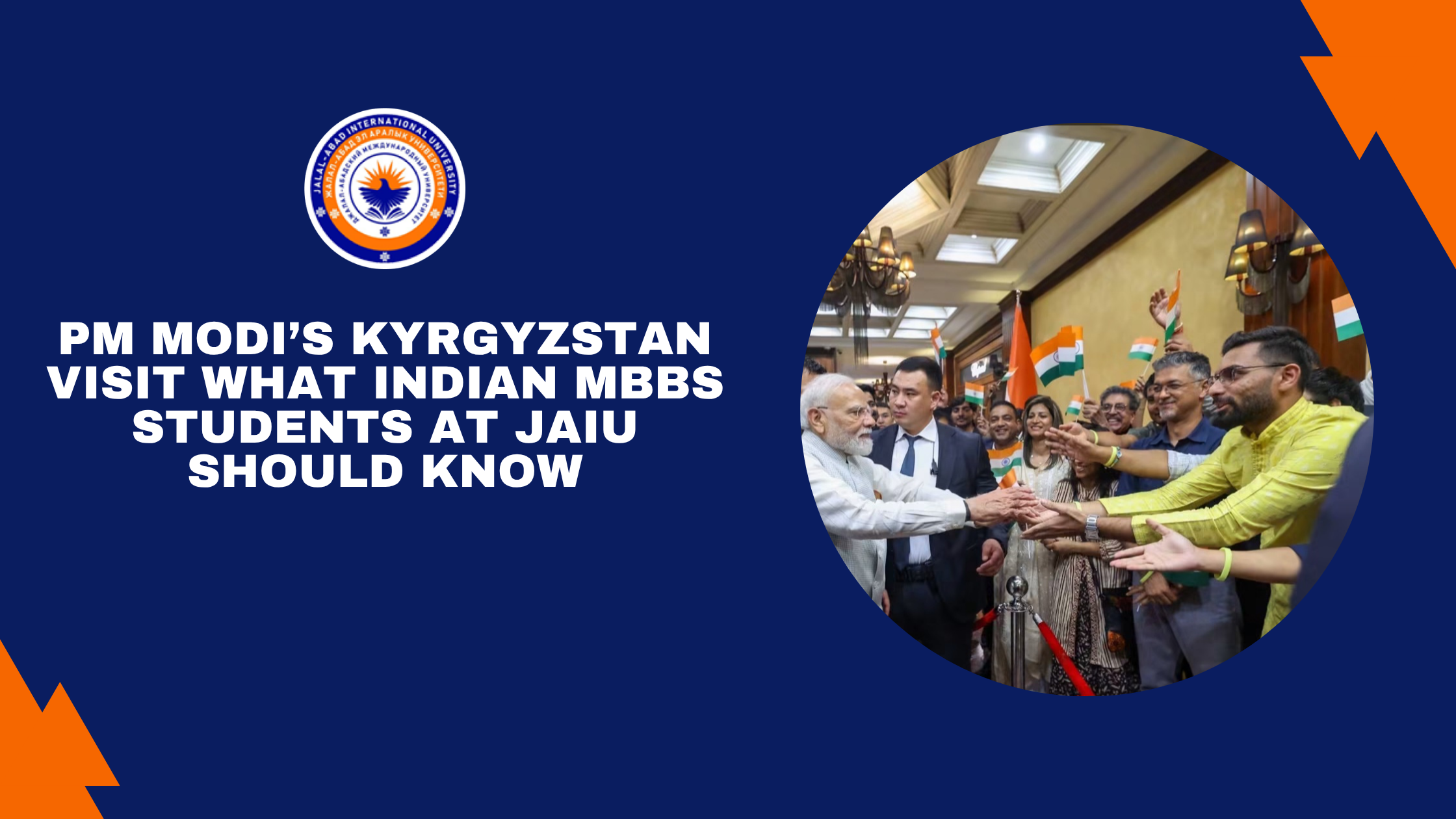
Prime Minister Narendra Modi recently completed his visit to Kyrgyzstan, where he participated in the 26th Shanghai Cooperation Organisation (SCO) Summit in Bishkek from August 31 to September 1, 2026. The visit was significant for India’s engagement with Central Asia and also brought attention to areas such as education, people-to-people relations, connectivity and regional cooperation.
For Indian students studying medicine in Kyrgyzstan, including students at Jalal-Abad International University (JAIU), the visit is particularly relevant because Kyrgyzstan has been an important destination for Indian medical students. India and Kyrgyzstan have maintained cooperation in education and health, while Kyrgyzstan continues to attract international students pursuing medical education.
PM Modi visited Kyrgyzstan as part of his four-day trip to Uzbekistan and the Kyrgyz Republic from August 29 to September 1, 2026. In Bishkek, he attended the 26th SCO Summit, which marked 25 years of the organisation.
During the summit, PM Modi highlighted India's vision for the next phase of SCO cooperation around three important pillars:
Security, Connectivity and Opportunity.
He said that the organisation should move from shared geography towards shared opportunities, with stronger people-driven partnerships and concrete outcomes.
For students and young professionals, the focus on opportunity and people-to-people connections is particularly important because education and youth exchanges are an important part of India's broader engagement with Central Asia.
One of the major themes of PM Modi's address was regional peace and security.
At the SCO Summit, he called for greater cooperation against terrorism and its financing. India pushed for stronger action against the entire ecosystem that supports terrorism.
Modi also emphasised that conflicts should be addressed through dialogue and diplomacy rather than warfare. He pointed to the wider consequences of conflicts for energy security, trade and global supply chains.
This message reflects India's broader diplomatic position that dialogue and peaceful resolution should remain central to addressing international conflicts.
PM Modi also referred to the famous Kyrgyz writer Chingiz Aitmatov during his SCO address.
He highlighted Aitmatov's idea that people often focus on the things that divide them instead of the things that unite them. Modi connected this thought to the SCO's future and called for greater cooperation among its diverse member states.
He concluded this part of his message with the idea of moving:
“from shared geography to shared opportunities”
and
“from government-driven cooperation to people-driven partnership.”
For students, this people-to-people approach is important because educational exchanges can become a bridge between India and Central Asian countries.
PM Modi's visit does not mean that any new special rule or direct benefit has automatically been announced for Indian MBBS students.
However, the visit highlights the broader importance of India-Kyrgyzstan relations.
Kyrgyzstan has historically been a destination for Indian medical students. An earlier India-Kyrgyzstan joint statement noted that Kyrgyzstan was among the destinations chosen by Indian medical students and highlighted cooperation between the two countries in education and health.
For students currently studying medicine in Kyrgyzstan, stronger bilateral engagement can be positive for the wider education ecosystem, student exchanges and people-to-people relations.
However, students should distinguish between diplomatic cooperation and specific medical education regulations. Admission, recognition, licensing and eligibility for practising medicine in India continue to depend on the applicable regulatory requirements.
For Jalal-Abad International University (JAIU), the broader India-Kyrgyzstan relationship is particularly relevant because the university has an international medical education programme and attracts students from countries including India.
JAIU currently describes its medical programme as an MD/MBBS-equivalent programme and states that its international programme is taught in English. The university also lists clinical training and practical learning among its medical education facilities.
The university has also recently focused on helping international students prepare for their future careers. In January 2026, JAIU announced a partnership with Arise Medical Academy in India for FMGE/NEXT preparation for its final-year medical students. The programme is designed to provide India-aligned preparation while students remain connected with their medical education in Kyrgyzstan.
This kind of India-focused academic support can be particularly relevant for students planning to return to India after completing their medical education.
The latest information available from JAIU also indicates continued academic and institutional development.
JAIU has reported that its 2025–2026 academic staff attestation process was completed using a structured evaluation system. The assessment considered teaching, academic work, research, clinical activities, international cooperation and participation in quality-management and accreditation processes.
The university has also published information about its Medical Faculty and its General Medicine programmes, including a six-year programme and a programme for foreign citizens based on 12-year education.
For prospective students, this means that choosing a medical university should involve looking beyond only tuition fees. Students should consider the curriculum, clinical exposure, faculty, academic support, regulatory requirements and preparation for future licensing examinations.
The relationship between India and Kyrgyzstan extends beyond politics.
Education, healthcare, culture and people-to-people connections are important components of the relationship. PM Modi's 2026 visit further placed Central Asia within India's broader strategic and economic engagement.
For Indian medical students, stronger educational ties could potentially create more opportunities for academic collaboration and exchanges in the future. But such opportunities should not be confused with an automatic change in India's medical licensing rules.
Students planning to study medicine abroad should continue to verify the latest requirements issued by the National Medical Commission (NMC) and other relevant authorities.
The Embassy of India in Bishkek has also issued an advisory for Indian students planning to study medicine in Kyrgyzstan. The advisory warns students and parents to carefully verify educational consultants, contractual obligations and university-related information before making payments.
For JAIU students, PM Modi's visit can be viewed as another sign of the continuing importance of India-Kyrgyzstan people-to-people relations.
Students are not only studying in another country; they are also becoming part of a wider educational connection between India and Kyrgyzstan.
The combination of international medical education in Kyrgyzstan and India-focused academic initiatives can help students better understand both systems.
JAIU has also highlighted its support for students preparing for their future professional journey, including FMGE/NEXT-oriented preparation through its partnership with an Indian medical education provider.
While the diplomatic relationship between India and Kyrgyzstan continues to develop, students should make education decisions based on verified information.
Before taking admission to any medical university in Kyrgyzstan, Indian students should check:
JAIU's own applicant information states that NEET is required for Indian students, and its current admissions information provides details about documentation and the international admission process.
PM Narendra Modi's recent Kyrgyzstan visit in 2026 was primarily focused on India's engagement with Central Asia and the SCO. His message in Bishkek centred on security, connectivity and opportunity, while also emphasising dialogue, cooperation and people-to-people partnerships.
For Indian MBBS students, the visit is significant because Kyrgyzstan has long been an important destination for Indian medical education, and India-Kyrgyzstan relations include cooperation in education and healthcare.
For Jalal-Abad International University (JAIU), the broader development provides a useful context for discussing international medical education, India-Kyrgyzstan connections and the university's recent academic initiatives.
At the same time, students should remember that PM Modi's visit did not itself announce a new automatic recognition or licensing benefit for JAIU or Indian MBBS students. Students should always verify current medical education and licensing requirements through the appropriate official authorities.
All Blog Posts

 Jalal-Abad State University Gets Key Clarification for Indian MBBS Aspirants in Kyrgyzstan
How JAIU Students Can Make Their Clinical Training More Meaningful
India–Kyrgyzstan Relations 2026: A New Chapter for Students at JAIU
How Technology Is Transforming Medical Education at JA
From Classroom to Clinic: How JAIU Students Develop Practical Medical Skills
Jalal-Abad State University Gets Key Clarification for Indian MBBS Aspirants in Kyrgyzstan
How JAIU Students Can Make Their Clinical Training More Meaningful
India–Kyrgyzstan Relations 2026: A New Chapter for Students at JAIU
How Technology Is Transforming Medical Education at JA
From Classroom to Clinic: How JAIU Students Develop Practical Medical Skills