Date: Sep 13, 2026 Day: Sunday
Medical education is changing as technology becomes a bigger part of how students learn, practise and assess their knowledge. Traditional lectures and textbooks remain important, but modern medical students can also learn through digital resources, simulation technologies, online academic platforms and technology-supported clinical training.
At Jalal-Abad International University (JAIU), technology is becoming part of different stages of the medical education experience. From digital learning resources and electronic academic systems to simulation-based clinical training and emerging VR/AR technologies, students can use a combination of traditional and modern learning methods during their medical education.
Medical students today have access to considerably more learning resources than simply classroom notes and textbooks.
JAIU provides students with digital academic resources through its eBilim system and E-Library. The university's student information describes eBilim as a platform through which enrolled students can access their timetable, grades and study materials. JAIU also maintains an E-Library for academic and medical resources.
Digital access can make studying more flexible because students can review academic material beyond scheduled classroom hours.
For students who prefer combining classroom learning with independent study, digital resources can become an additional part of their daily academic routine.
Technology is not limited to medical equipment.
An important part of a modern university environment is the digital management of academic information.
JAIU's eBilim system supports access to areas such as timetables, grades and study materials. The university also has formal regulations covering digital educational resources and the use of the eBilim learning-management system.
For students, having academic information available through a digital system can make it easier to keep track of their studies and organise their learning.
Instead of depending entirely on physical notices or classroom announcements, students can use digital platforms as part of their academic workflow.
One of the most important applications of technology in medical education is simulation.
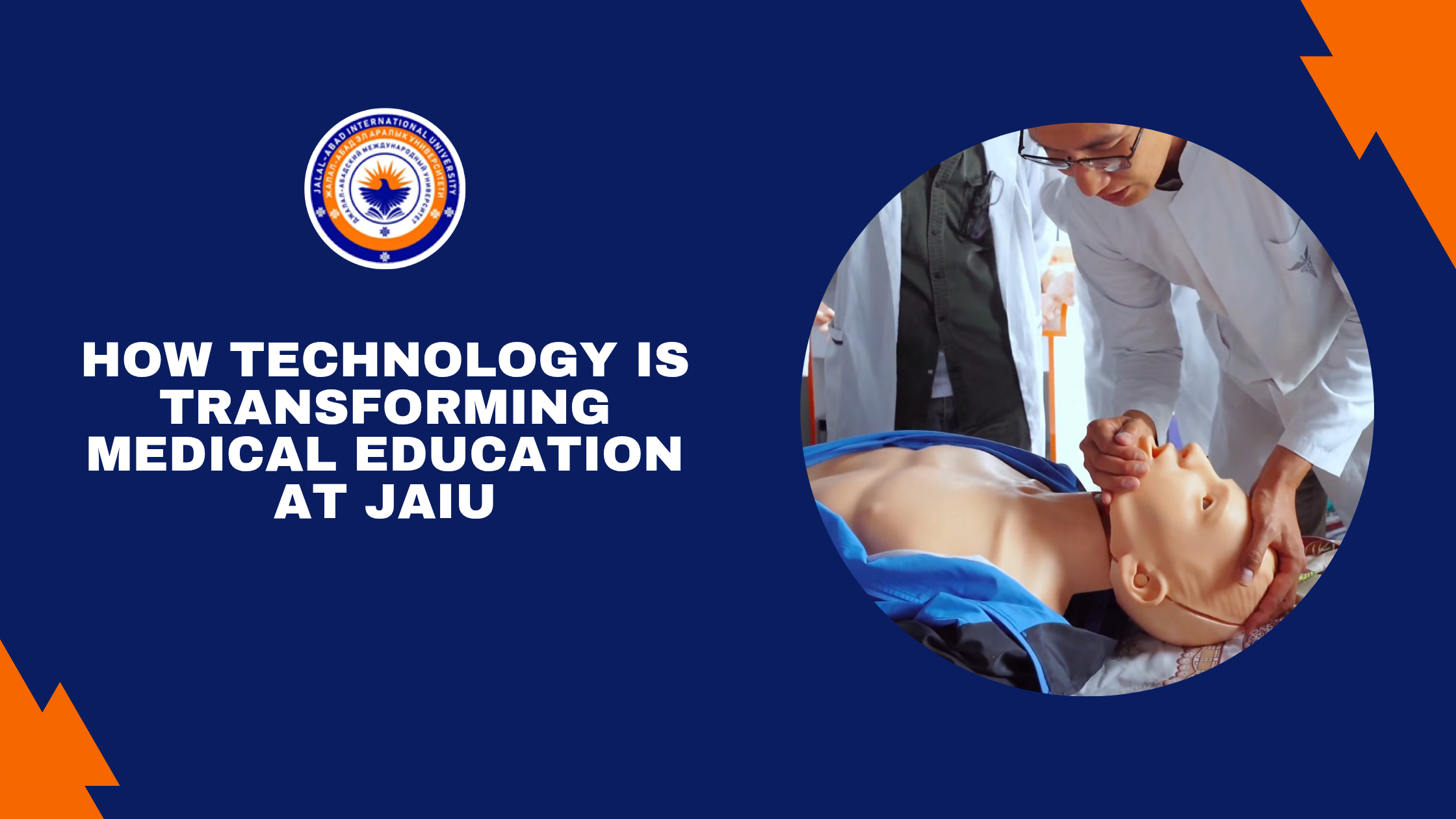
JAIU's Simulation Center provides students with a controlled environment in which they can practise clinical skills before working with real patients. The center uses simulation equipment, phantoms, standardized patients and structured scenarios as part of practical training.
This allows students to practise procedures repeatedly and receive guidance from instructors.
Simulation can also help bridge the gap between theoretical knowledge and clinical practice. A student may first learn a procedure in class, then practise it in a simulation environment before encountering a similar situation during clinical training.
JAIU's Simulation Center information states that the university is developing digital simulations and incorporating VR/AR elements and interactive learning formats.
Virtual Reality (VR) and Augmented Reality (AR) can provide new ways of visualising medical concepts and practising certain scenarios.
For example, technology-supported learning can potentially make complex anatomical structures easier to visualise or allow students to interact with simulated clinical situations.
These technologies do not replace teachers or real clinical experience. Instead, they can serve as additional tools within a broader medical education system.
Medical education requires students to develop practical skills, not just theoretical knowledge.
JAIU's simulation training progresses from basic communication and patient-care skills toward diagnostic and therapeutic procedures, clinical case analysis and more advanced practical competencies.
Technology can support this progression by giving students opportunities to practise in a structured environment.
For beginners, this can be particularly useful because they can focus on learning the correct sequence of a procedure before applying their knowledge in real clinical settings under appropriate supervision.
Technology can also change how students are assessed.
JAIU uses OSCE and OSPE as part of practical medical assessment. Its current student resources also list regulations covering OSCE/OSPE, Mini-CEX, DOPS, 360-degree assessment and other clinical assessment methods.
The Simulation Center also describes the use of OSCE/OSPE together with eBilim, testing and ongoing monitoring as part of educational assessment and quality assurance.
This combination allows practical performance and theoretical knowledge to be assessed through different methods rather than relying only on traditional written examinations.
Technology has also changed how medical students access information.
JAIU's E-Library provides students with digital academic resources. The university describes its digital collection as supporting medical study, research and preparation for examinations and includes online books, journals and other academic resources.
For medical students, digital access can be particularly useful because medicine is a constantly developing field.
Students can use academic databases and digital literature to explore topics beyond their classroom material and develop stronger research habits.
A modern medical student is not expected to learn only during classroom hours.
Digital resources can support independent learning by allowing students to:
At JAIU, the availability of digital learning resources and electronic academic systems provides students with additional tools for independent study.
However, technology is most useful when students use it purposefully. Simply having access to digital resources does not replace consistent study and academic discipline.
Technology can provide information and simulations, but medical education still depends heavily on teachers and clinical mentors.
Students need faculty members to explain difficult concepts, correct practical mistakes, provide feedback and help them understand the clinical context of what they are learning.
JAIU's simulation-based training is conducted within a structured educational environment, with students progressing through practical skills under teacher supervision.
This combination of technology and human guidance is important because becoming a doctor involves communication, judgement, professionalism and patient interaction—skills that cannot be developed through technology alone.
Healthcare itself is becoming increasingly technology-driven.
Doctors work with electronic records, diagnostic equipment, imaging technologies, laboratory systems, digital medical literature and other technology-supported tools.
Medical students therefore benefit from becoming comfortable with technology during their education.
Learning how to use digital academic systems, evaluate online medical information and interact with technology-supported clinical training can help students become more adaptable to modern healthcare environments.
Despite the growing role of technology, real clinical experience remains an essential part of medical education.
Simulation can allow students to practise safely, but it cannot completely reproduce the complexity of real patients.
JAIU combines simulation-based training with education at clinical bases, allowing students to gradually move from controlled practical learning toward supervised clinical environments.
This creates a progression:
Classroom learning → Digital resources → Simulation → Practical assessment → Supervised clinical training
Each stage serves a different purpose.
Students can make technology more useful by incorporating it into their regular study habits.
Instead of relying only on class notes, students can use the E-Library and approved academic resources to explore difficult topics.
Simulation opportunities can be used to become familiar with clinical procedures before entering real patient-care environments.
Digital academic systems can help students keep track of schedules, grades and study materials.
Students can use digital academic literature to compare studies and learn how medical evidence is developed.
Digital tools should support classroom teaching and clinical learning rather than replace them.
Technology in medical education is likely to continue developing.
JAIU's current Simulation Center information already identifies digital simulation, VR/AR elements and interactive learning as areas being developed by the university.
At the same time, JAIU's 2026 quality and policy information includes dedicated regulations for IT services and digital infrastructure, simulation and pre-clinical training, and digital educational resources.
This suggests that digital infrastructure is being incorporated into the university's broader educational framework rather than being treated as a separate feature.
Technology is changing medical education by giving students new ways to learn, practise and assess their skills.
At JAIU, this includes digital academic systems such as eBilim, access to an E-Library, simulation-based clinical training, OSCE/OSPE assessment and the development of digital simulation and VR/AR learning technologies.
For medical students, the value of technology depends on how effectively they use it. Digital resources can strengthen independent learning, simulation can provide a safe environment for practical training, and technology-supported assessment can provide additional ways to evaluate clinical competencies.
Ultimately, technology works best when combined with strong teaching, practical experience, clinical supervision and consistent student effort. The goal is not to replace traditional medical education, but to create a learning environment where students can connect knowledge, technology and clinical practice more effectively.
All Blog Posts

 Jalal-Abad State University Gets Key Clarification for Indian MBBS Aspirants in Kyrgyzstan
How JAIU Students Can Make Their Clinical Training More Meaningful
India–Kyrgyzstan Relations 2026: A New Chapter for Students at JAIU
From Classroom to Clinic: How JAIU Students Develop Practical Medical Skills
PM Modi’s Kyrgyzstan Visit and the Growing India–Kyrgyzstan Education Connection: What It Means for JAIU Students
Jalal-Abad State University Gets Key Clarification for Indian MBBS Aspirants in Kyrgyzstan
How JAIU Students Can Make Their Clinical Training More Meaningful
India–Kyrgyzstan Relations 2026: A New Chapter for Students at JAIU
From Classroom to Clinic: How JAIU Students Develop Practical Medical Skills
PM Modi’s Kyrgyzstan Visit and the Growing India–Kyrgyzstan Education Connection: What It Means for JAIU Students