Date: Jul 09, 2026 Day: Thursday
A successful medical career depends on more than academic knowledge. Future doctors must develop clinical skills, critical thinking, communication abilities, and the confidence to apply medical concepts in real healthcare settings. Building these competencies begins early in medical education through structured learning and practical exposure.
Jalal-Abad International University (JAIU), Kyrgyz Republic, focuses on helping students develop a strong clinical foundation by combining classroom education with laboratory training, clinical observation, and patient-centered learning. Through a well-structured MBBS curriculum and modern teaching methods, the university prepares students for the responsibilities of medical practice.
The journey toward becoming a competent doctor starts with a strong understanding of basic medical sciences.
JAIU follows a structured MBBS curriculum that gradually progresses from foundational subjects to advanced clinical disciplines. During the early years, students study:
Human Anatomy
Physiology
Biochemistry
Histology
Microbiology
Pathology
Pharmacology
These subjects provide the scientific knowledge necessary for understanding diseases, diagnosis, and patient care in later clinical years.
Anatomy is one of the most important subjects in medical education.
At JAIU, students spend considerable time learning the structure of the human body through classroom instruction and practical sessions. Anatomy laboratories help students understand organs, muscles, nerves, blood vessels, and body systems in detail.
A thorough understanding of anatomy becomes the foundation for surgery, internal medicine, radiology, and many other medical specialties.
Medical education requires practical experience alongside theoretical instruction.
JAIU provides laboratory sessions where students perform experiments, observe specimens, and apply scientific principles learned in lectures.
Practical laboratory education helps students:
Improve observation skills
Understand biological processes
Develop scientific thinking
Connect theory with practice
These experiences prepare students for future clinical decision-making.
Although the initial years primarily focus on basic sciences, students are gradually introduced to the principles of clinical medicine.
Faculty members use clinical examples and case-based discussions to demonstrate how classroom concepts relate to patient care. This approach helps students begin thinking like future healthcare professionals from the beginning of their education.
As students advance through the MBBS program, clinical education becomes a central part of learning.
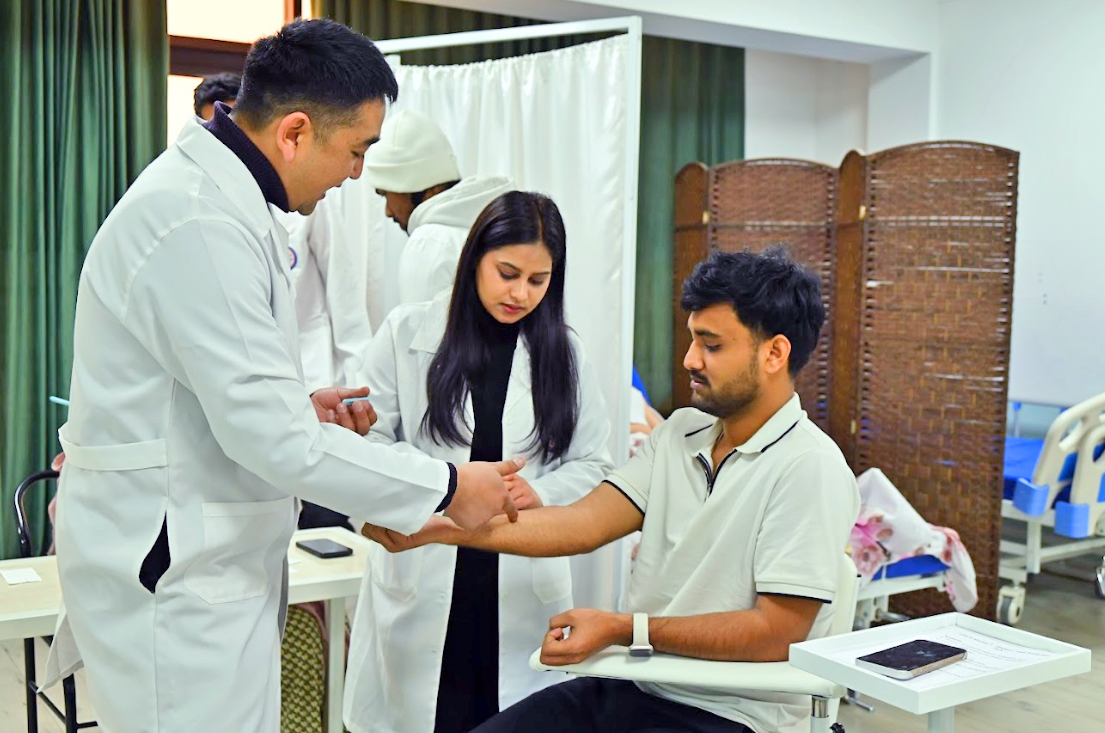
JAIU integrates hospital-based clinical exposure into its curriculum, allowing students to observe experienced doctors, understand patient management, and become familiar with healthcare environments under academic supervision.
Clinical training helps students understand:
Patient history taking
Physical examination techniques
Diagnosis
Treatment planning
Medical documentation
Professional communication
These practical experiences bridge the gap between theoretical education and real medical practice.
Case-based learning is an important teaching method in modern medical education.
Faculty members present clinical scenarios that encourage students to analyze symptoms, interpret findings, and discuss possible diagnoses.
This teaching approach develops:
Critical thinking
Clinical reasoning
Problem-solving abilities
Decision-making skills
Students learn to apply medical knowledge instead of simply memorizing textbook information.
Clinical education depends greatly on the expertise of medical educators.
JAIU's faculty includes experienced professors, physicians, and healthcare professionals who share both academic knowledge and practical medical experience.
Through lectures, demonstrations, and clinical discussions, faculty members guide students in developing professional competence and ethical medical practice.
Effective communication is an essential part of patient care.
JAIU encourages students to develop professional communication skills that help them interact respectfully with patients, classmates, faculty members, and healthcare teams.
Learning clear communication early prepares students for future clinical responsibilities and multidisciplinary teamwork.
Medical education continues to evolve with advances in healthcare and technology.
JAIU incorporates modern educational methods such as:
Interactive lectures
Clinical demonstrations
Practical laboratory sessions
Group discussions
Problem-based learning
Digital learning resources
These methods promote active participation and improve students' understanding of complex medical concepts.
Clinical competence involves more than scientific knowledge.
Students at JAIU are introduced to important principles such as:
Medical ethics
Professional responsibility
Patient confidentiality
Respectful patient care
Teamwork
Professional behavior
Developing these qualities helps prepare students for responsible medical practice throughout their careers.
Regular evaluation helps students strengthen their clinical knowledge over time.
Throughout the MBBS program, students participate in:
Practical examinations
Internal assessments
Laboratory evaluations
Oral presentations
Written examinations
Continuous assessment allows both students and faculty to identify areas for improvement before progressing to advanced clinical training.
Learning from a variety of clinical situations broadens students' medical understanding.
As students participate in clinical training, they gain exposure to patients with different medical conditions and healthcare needs. This experience enhances their ability to recognize symptoms, understand disease progression, and appreciate the importance of evidence-based medical care.
JAIU's clinical training aims to prepare students for professional healthcare environments by developing competencies in:
Clinical observation
Patient interaction
Diagnostic reasoning
Medical ethics
Team collaboration
Professional communication
Lifelong learning
These skills support graduates as they continue their medical education and future professional development.
Strong clinical foundations benefit students throughout their medical careers by helping them:
Understand diseases more effectively
Apply theoretical knowledge in practice
Build confidence in patient care
Improve communication skills
Develop professional judgment
Adapt to clinical responsibilities
Become compassionate healthcare professionals
These competencies are essential for delivering safe and effective medical care.
International students choose Jalal-Abad International University because it provides:
A structured MBBS curriculum
Practical laboratory education
Clinical hospital exposure
Experienced medical faculty
Modern teaching methods
Student-centered learning
English-medium instruction
Government recognition
Internationally recognized academic standards
A supportive learning environment
These features help students build a strong academic and clinical foundation throughout their medical education.
Clinical excellence begins with a strong educational foundation. Jalal-Abad International University prepares future doctors by combining theoretical learning with practical laboratory work, clinical observation, experienced faculty guidance, and patient-centered education.
By gradually introducing students to real-world medical practice while strengthening their scientific knowledge, JAIU helps develop the confidence, competence, and professionalism needed for a successful career in medicine. For international students seeking a balanced approach to medical education, JAIU offers an environment that supports both academic achievement and long-term clinical development.
All Blog Posts

 Jalal-Abad State University Gets Key Clarification for Indian MBBS Aspirants in Kyrgyzstan
How JAIU Students Can Make Their Clinical Training More Meaningful
India–Kyrgyzstan Relations 2026: A New Chapter for Students at JAIU
How Technology Is Transforming Medical Education at JA
From Classroom to Clinic: How JAIU Students Develop Practical Medical Skills
Jalal-Abad State University Gets Key Clarification for Indian MBBS Aspirants in Kyrgyzstan
How JAIU Students Can Make Their Clinical Training More Meaningful
India–Kyrgyzstan Relations 2026: A New Chapter for Students at JAIU
How Technology Is Transforming Medical Education at JA
From Classroom to Clinic: How JAIU Students Develop Practical Medical Skills