
Date: Jul 12, 2026 Day: Sunday
Medical education is built on two essential pillars—strong theoretical knowledge and practical learning. While classroom lectures help students understand medical concepts, laboratory training enables them to apply that knowledge through observation, experimentation, and hands-on practice. For aspiring doctors, laboratory experience is the first step toward developing scientific thinking and clinical competence.
Jalal-Abad International University (JAIU), Kyrgyz Republic, recognizes the importance of practical education and integrates laboratory training throughout its MBBS program. From the first year of study, students spend time in medical laboratories where they gain a deeper understanding of human anatomy, physiology, biochemistry, microbiology, pathology, and other essential medical sciences.
This article explores the role of medical laboratories at JAIU and how they contribute to preparing future healthcare professionals.
Medicine is a science-based profession that requires students to understand the human body through both theory and practice.
Medical laboratories allow students to:
Observe scientific processes firsthand
Understand biological structures and functions
Perform practical experiments
Develop analytical thinking
Improve observation skills
Build confidence before entering clinical training
Laboratory education bridges the gap between classroom learning and patient care, making it an essential part of every medical student's journey.
At JAIU, practical education begins early in the MBBS program.
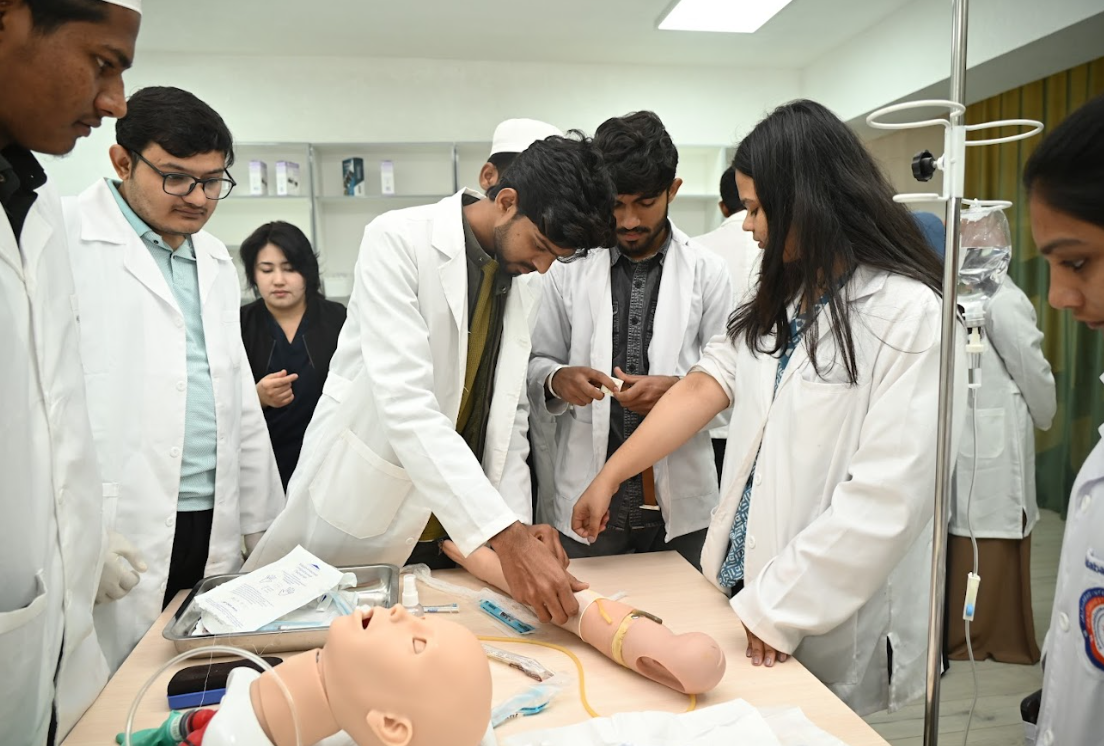
During the first year, students are introduced to laboratory work alongside theoretical lectures. This balanced approach helps students understand medical concepts more effectively by allowing them to apply what they learn in real laboratory settings.
Early practical exposure also helps students become familiar with scientific equipment, laboratory procedures, and professional working practices.
Human Anatomy is one of the most fundamental subjects in medical education.
The anatomy laboratory at JAIU provides students with opportunities to study the structure of the human body in detail. Through practical demonstrations and guided learning, students develop a clear understanding of bones, muscles, organs, blood vessels, nerves, and body systems.
A strong understanding of anatomy forms the foundation for future studies in surgery, radiology, orthopedics, and other clinical specialties.
Understanding how the human body functions is equally important.
In physiology laboratories, students learn about the normal functioning of various body systems through practical demonstrations and experiments. Topics such as cardiovascular function, respiratory physiology, nervous system activity, and muscle function are explored in a structured learning environment.
These practical sessions help students connect scientific theories with real biological processes.
Biochemistry explains the chemical processes that sustain life.
Laboratory sessions in biochemistry allow students to understand the role of proteins, enzymes, carbohydrates, lipids, vitamins, and other biochemical components within the human body.
Students also gain practical experience in performing basic biochemical analyses and interpreting laboratory findings.
Microbiology plays a vital role in understanding infectious diseases.
Through microbiology practical sessions, students learn about microorganisms such as bacteria, viruses, fungi, and parasites. Laboratory training introduces students to specimen handling, microscopic observation, culture techniques, and infection control principles.
These practical experiences help students understand disease transmission and the importance of laboratory diagnosis.
Pathology focuses on the study of diseases and their effects on the human body.
At JAIU, pathology laboratory sessions help students examine tissue changes, disease mechanisms, and microscopic specimens. Students develop an understanding of how diseases affect organs and body systems, preparing them for clinical diagnosis in later years.
Effective practical education depends on appropriate laboratory facilities.
JAIU aims to provide laboratories equipped with educational tools and scientific instruments that support medical learning. Access to modern laboratory equipment enables students to conduct practical exercises safely and efficiently under faculty supervision.
Learning to use scientific instruments correctly is an important skill for future healthcare professionals.
Laboratory education requires expert supervision.
Experienced faculty members guide students during practical classes, explaining scientific concepts, demonstrating procedures, and helping students interpret experimental observations.
Faculty members also encourage students to ask questions, analyze results, and understand the clinical relevance of each practical exercise.
Laboratory education is about much more than completing experiments.
Through practical sessions, students learn how to:
Observe carefully
Record findings accurately
Analyze scientific evidence
Draw logical conclusions
Solve problems systematically
These skills become essential throughout medical education and future clinical practice.
Laboratory learning prepares students for hospital-based education.
Before interacting with patients, students must understand human biology, disease mechanisms, and diagnostic principles. Practical laboratory education provides this foundation by strengthening scientific knowledge and improving technical understanding.
As students progress through the MBBS program, laboratory experience makes the transition to clinical learning much smoother.
Medical laboratories also teach professional responsibility.
Students learn the importance of:
Laboratory safety
Proper handling of equipment
Maintaining hygiene
Following scientific procedures
Respecting ethical standards
Accurate documentation
These professional habits become essential during future clinical practice.
One of the greatest advantages of laboratory education is its ability to reinforce classroom learning.
After attending lectures, students immediately apply theoretical concepts through practical exercises. This integrated learning approach improves knowledge retention and helps students understand complex medical concepts more effectively.
Rather than memorizing information, students learn through observation and experience.
The skills developed in medical laboratories extend beyond academics.
Laboratory training helps students build:
Scientific knowledge
Technical competence
Critical thinking
Analytical ability
Professional discipline
Confidence in practical work
These qualities contribute significantly to becoming competent and responsible healthcare professionals.
Medical laboratories are an essential component of the MBBS curriculum because they help students:
Strengthen theoretical understanding
Develop practical medical skills
Improve scientific observation
Learn diagnostic principles
Prepare for hospital-based clinical training
Build confidence before patient interaction
Develop professional laboratory practices
This combination of theoretical and practical education supports comprehensive medical learning.
Medical laboratories play a crucial role in shaping the education of every future doctor. At Jalal-Abad International University (JAIU), laboratory training is integrated throughout the MBBS curriculum to ensure that students develop both scientific knowledge and practical competence.
From anatomy and physiology to microbiology, pathology, and biochemistry, laboratory sessions provide students with valuable hands-on experience that complements classroom learning. Under the guidance of experienced faculty, students gain the skills, confidence, and analytical abilities needed for future clinical training and professional medical practice.
By emphasizing practical education alongside academic excellence, JAIU helps international students build a strong foundation for successful careers in medicine.
All Blog Posts

 Jalal-Abad State University Gets Key Clarification for Indian MBBS Aspirants in Kyrgyzstan
How JAIU Students Can Make Their Clinical Training More Meaningful
India–Kyrgyzstan Relations 2026: A New Chapter for Students at JAIU
How Technology Is Transforming Medical Education at JA
From Classroom to Clinic: How JAIU Students Develop Practical Medical Skills
Jalal-Abad State University Gets Key Clarification for Indian MBBS Aspirants in Kyrgyzstan
How JAIU Students Can Make Their Clinical Training More Meaningful
India–Kyrgyzstan Relations 2026: A New Chapter for Students at JAIU
How Technology Is Transforming Medical Education at JA
From Classroom to Clinic: How JAIU Students Develop Practical Medical Skills